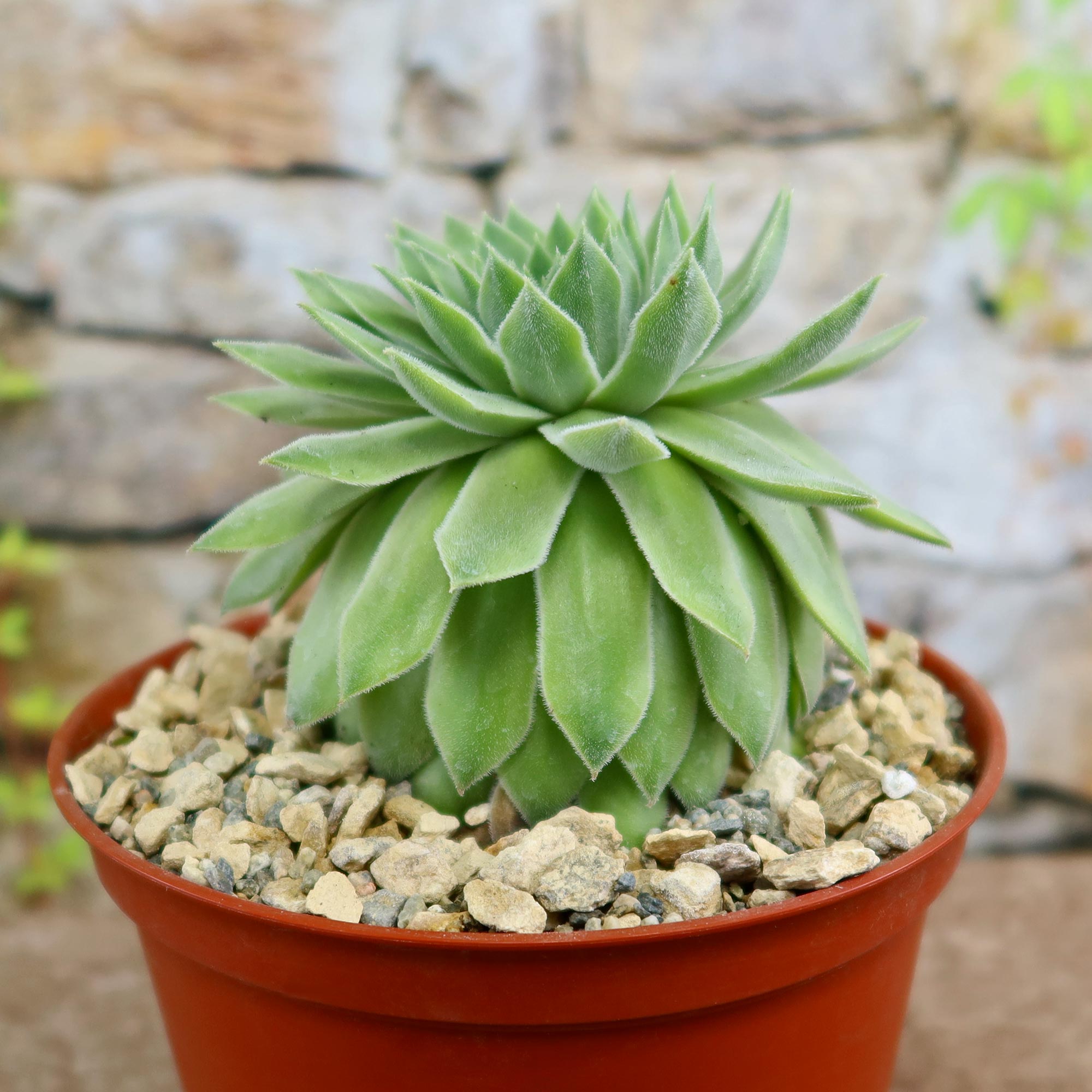
The Sempervivum tectorum var. glaucum is a hardy, eye-catching succulent prized for its cool blue-gray rosettes and cold-hardy resistance. The name “Sempervivum” means “always living,” a nod to the plant’s remarkable hardiness and ability to survive cold, drought, and poor soils. While it is primarily an outdoor plant, it can also be grown indoors in very bright light.
 Native to Southern Europe, the Sempervivum tectorum var. glaucum forms compact, symmetrical rosettes of fleshy leaves coated in a glaucous (bluish-gray) waxy layer.
The leaves often develop subtle pink or purple tones along the edges when exposed to cool temperatures or strong sunlight.
The plant spreads by producing offsets, known as “chicks,” that cluster tightly around the mother rosette.
At maturity, individual rosettes typically grow up to 6 inches wide, while clumps can spread much wider over time.
Like all Sempervivums, this plant is monocarpic, meaning each rosette flowers once and then dies. The flowers appear on tall, upright stalks in summer and are usually star-shaped and pink to reddish, attracting bees and other pollinators.
When it comes to caring for your Sempervivum tectorum var. glaucum is straightforward; it prefers well-drained succulent soil, such as a cactus or alpine mix. Water sparingly, allowing the soil to dry completely between waterings.

Indoors, provide bright direct light and cool to moderate temperatures, ideally between 60–75°F.
Outdoors, it thrives in USDA Zones 3–9 and performs best in full sun, which enhances color and compact growth.
Fertilization is rarely needed; if desired, use a diluted, low-nitrogen fertilizer once in spring.
Overall, the Sempervivum tectorum var. glaucum is a timeless, low-maintenance succulent that combines beauty, durability, and historical charm. Whether planted outdoors in rock gardens and containers or displayed in bright indoor settings, it offers year-round interest with minimal effort. For gardeners seeking a tough yet elegant succulent that truly lives up to its name, this houseleek is an outstanding choice.
Bloom Season
Flower Color
Growth Rate
Hardiness Zone
Mature Size
Plant Type
Resistance
Sun Exposure
Watering Needs
| Attribute | Value |
|---|---|
| Bloom Season | Summer |
| Botanical Name | Sempervivum Tectorum var. Glaucum |
| Dormancy | Winter |
| Family | Crassulaceae |
| Flower Color | Pink, reddish |
| Genus | Sempervivum |
| Growth Habit | Rosette |
| Growth Rate | Moderate |
| Hardiness Zone | 3, 4, 5, 6, 7, 8, 9 |
| Mature Size | 6 in. wide |
| Native Area | Southern Europe |
| Plant Type | Succulent |
| Propagation | By cuttings |
| Resistance | Extremely drought-tolerant, mild frost tolerant, pest resistance |
| Soil PH | 6.5, Acidic, Neutral |
| Soil Type | Succulents potting mix soil |
| Special Features | Easy to maintain, easy to grow |
| Sun Exposure | Full sun (6+ hrs.), Partial shade (3–6 hrs. sun) |
| Toxicity | Safe for humans, friendly to dogs, friendly to cats |
| Watering Needs | Low |
Growers Quick Reference Guide - Key Features
| Attribute | Value |
|---|---|
| Bloom Season | Summer |
| Botanical Name | Sempervivum Tectorum var. Glaucum |
| Dormancy | Winter |
| Family | Crassulaceae |
| Flower Color | Pink, reddish |
| Genus | Sempervivum |
| Growth Habit | Rosette |
| Growth Rate | Moderate |
| Hardiness Zone | 3, 4, 5, 6, 7, 8, 9 |
| Mature Size | 6 in. wide |
| Native Area | Southern Europe |
| Plant Type | Succulent |
| Propagation | By cuttings |
| Resistance | Extremely drought-tolerant, mild frost tolerant, pest resistance |
| Soil PH | 6.5, Acidic, Neutral |
| Soil Type | Succulents potting mix soil |
| Special Features | Easy to maintain, easy to grow |
| Sun Exposure | Full sun (6+ hrs.), Partial shade (3–6 hrs. sun) |
| Toxicity | Safe for humans, friendly to dogs, friendly to cats |
| Watering Needs | Low |
- Description
- Key Plant Features
The Sempervivum tectorum var. glaucum is a hardy, eye-catching succulent prized for its cool blue-gray rosettes and cold-hardy resistance. The name “Sempervivum” means “always living,” a nod to the plant’s remarkable hardiness and ability to survive cold, drought, and poor soils. While it is primarily an outdoor plant, it can also be grown indoors in very bright light.
Native to Southern Europe, the Sempervivum tectorum var. glaucum forms compact, symmetrical rosettes of fleshy leaves coated in a glaucous (bluish-gray) waxy layer.
The leaves often develop subtle pink or purple tones along the edges when exposed to cool temperatures or strong sunlight.
The plant spreads by producing offsets, known as “chicks,” that cluster tightly around the mother rosette.
At maturity, individual rosettes typically grow up to 6 inches wide, while clumps can spread much wider over time.
Like all Sempervivums, this plant is monocarpic, meaning each rosette flowers once and then dies. The flowers appear on tall, upright stalks in summer and are usually star-shaped and pink to reddish, attracting bees and other pollinators.
When it comes to caring for your Sempervivum tectorum var. glaucum is straightforward; it prefers well-drained succulent soil, such as a cactus or alpine mix. Water sparingly, allowing the soil to dry completely between waterings.
Indoors, provide bright direct light and cool to moderate temperatures, ideally between 60–75°F.
Outdoors, it thrives in USDA Zones 3–9 and performs best in full sun, which enhances color and compact growth.
Fertilization is rarely needed; if desired, use a diluted, low-nitrogen fertilizer once in spring.
Overall, the Sempervivum tectorum var. glaucum is a timeless, low-maintenance succulent that combines beauty, durability, and historical charm. Whether planted outdoors in rock gardens and containers or displayed in bright indoor settings, it offers year-round interest with minimal effort. For gardeners seeking a tough yet elegant succulent that truly lives up to its name, this houseleek is an outstanding choice.
Bloom Season
Flower Color
Growth Rate
Hardiness Zone
Mature Size
Plant Type
Resistance
Sun Exposure
Watering Needs
| Attribute | Value |
|---|---|
| Bloom Season | Summer |
| Botanical Name | Sempervivum Tectorum var. Glaucum |
| Dormancy | Winter |
| Family | Crassulaceae |
| Flower Color | Pink, reddish |
| Genus | Sempervivum |
| Growth Habit | Rosette |
| Growth Rate | Moderate |
| Hardiness Zone | 3, 4, 5, 6, 7, 8, 9 |
| Mature Size | 6 in. wide |
| Native Area | Southern Europe |
| Plant Type | Succulent |
| Propagation | By cuttings |
| Resistance | Extremely drought-tolerant, mild frost tolerant, pest resistance |
| Soil PH | 6.5, Acidic, Neutral |
| Soil Type | Succulents potting mix soil |
| Special Features | Easy to maintain, easy to grow |
| Sun Exposure | Full sun (6+ hrs.), Partial shade (3–6 hrs. sun) |
| Toxicity | Safe for humans, friendly to dogs, friendly to cats |
| Watering Needs | Low |
Growers Quick Reference Guide - Key Features
| Attribute | Value |
|---|---|
| Bloom Season | Summer |
| Botanical Name | Sempervivum Tectorum var. Glaucum |
| Dormancy | Winter |
| Family | Crassulaceae |
| Flower Color | Pink, reddish |
| Genus | Sempervivum |
| Growth Habit | Rosette |
| Growth Rate | Moderate |
| Hardiness Zone | 3, 4, 5, 6, 7, 8, 9 |
| Mature Size | 6 in. wide |
| Native Area | Southern Europe |
| Plant Type | Succulent |
| Propagation | By cuttings |
| Resistance | Extremely drought-tolerant, mild frost tolerant, pest resistance |
| Soil PH | 6.5, Acidic, Neutral |
| Soil Type | Succulents potting mix soil |
| Special Features | Easy to maintain, easy to grow |
| Sun Exposure | Full sun (6+ hrs.), Partial shade (3–6 hrs. sun) |
| Toxicity | Safe for humans, friendly to dogs, friendly to cats |
| Watering Needs | Low |