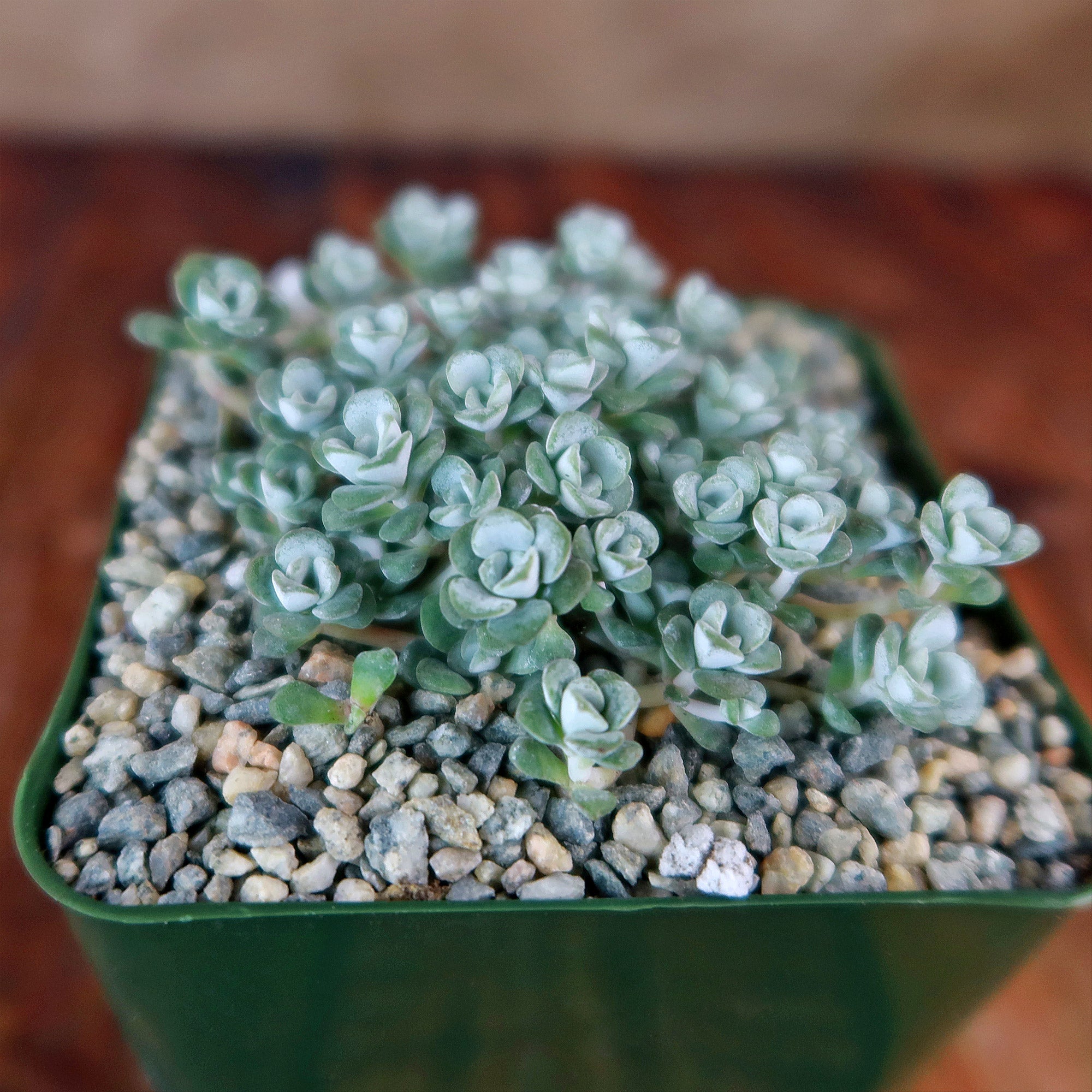
The Sedum spathulifolium 'Cape Blanco' is a ground-hugging evergreen perennial that forms an attractive carpet of powdery, gray-green thick leaves that are occasionally purple-tinged. Whether planted in rock gardens, containers, green roofs, or as a groundcover, this cold-hardy succulent offers long-lasting color and texture throughout the year, making it a popular choice in both residential and commercial designs.
Native to the rocky slopes and coastal bluffs of Western North America, particularly in Oregon, California, and British Columbia, it has tight rosettes on creeping stems with spoon-shaped, fleshy leaves, which are coated with a powdery white wax (known as farina). This coating gives the foliage a striking silvery or icy-blue appearance, which intensifies under bright sunlight and cool temperatures.

The plant forms a spreading mat, typically grows up to 4 inches tall and 18 inches wide at maturity, making it ideal as a living mulch or groundcover in drought-tolerant landscapes.
The flowers of this Sedum stonecrop bloom from late spring to early summer, lasting approximately 2 to 3 weeks.
During this time, clusters of bright yellow, star-shaped flowers rise just above the silver rosettes, creating a striking contrast.
The blooms typically start in the last week of spring and can continue into the first or second week of summer, providing a cheerful splash of color against the foliage.
The Sedum ‘Cape Blanco’ makes an excellent trailing or spilling plant for containers, rock walls, and vertical gardens. Its shallow root system and draping habit allow it to thrive in tight spaces where other plants might struggle.
Often used as a filler or spiller in succulent combinations, this plant adds texture and silvery-blue tones to arrangements. It's also well-suited to alpine gardens, patio crevices, or green roofs, making it a versatile choice for small-space or urban gardening.
When and How to Water Your Sedum spathulifolium
The Sedum spathulifolium is highly drought-tolerant, making it a fantastic low-maintenance choice for dry gardens, rock landscapes, and containers. This Sedum stonecrop has evolved to store water efficiently in its fleshy, silver-gray leaves. Always test the soil with your finger or a moisture meter to ensure it's dry at least 2 inches deep before watering again.
In the spring and summer, during their actively growing period, water moderately, typically every 10 to 14 days, if grown outdoors in full sun. Indoor plants may need water every 2 to 3 weeks, depending on temperature and humidity levels. It's important to let the soil dry out completely between watering sessions, especially during active growing seasons. Avoid splashing water directly on the foliage, which can cause rot.
In fall and winter, the plant enters dormancy, reduce watering to once a month or even less. Watch for shriveling leaves as a sign of dehydration, but err on the side of underwatering during dormancy to prevent root rot.
Light Requirements – Where to Place Your Sedum Cape Blanco

When grown indoors as a houseplant, your Sedum spathulifolium should be placed in the bright indirect sunlight, such as a south-facing window for at least 4 to 6 hours.
Without sufficient light, the plant may become leggy and lose its vibrant coloration. If natural light is limited, supplement with a grow light for 10–12 hours daily to mimic full sun exposure.
For outdoor growth, Sedum stonecrop thrives in full sun to partial shade, for at least 6 hours of direct sunlight daily for optimal growth and flowering.
In areas with intense heat, some afternoon shade can help prevent leaf scorches, especially during peak summer.
The silvery foliage reflects sunlight, making this sedum more tolerant of bright conditions than many green-leaved varieties. Full sun promotes tighter, more colorful rosettes and encourages the production of bright yellow flowers from late spring to early summer.
Optimal Soil & Fertilizer Needs
The Broadleaf Stonecrop performs best in a well-draining succulent mix. Good aeration prevents root rot, especially in cooler months when water evaporates more slowly. Raised beds or rocky slopes are ideal outdoor locations. If planting in the ground, amend heavy clay with sand, perlite, or pumice to improve drainage.
For containers, choose shallow pots with drainage holes, and avoid using regular garden soil. Instead, make or buy a well-draining potting mix, or ideally use our specialized succulent potting mix, opens in a new tab that contains 5 natural substrates and mycorrhizae to promote the development of a strong root system that helps your succulent to thrive. This species doesn’t require rich soil; in fact, too much organic matter can lead to excessive moisture retention and weak growth.
Fertilization is rarely necessary, but if desired, use a balanced, diluted NPK fertilizer (5-10-5) once in early spring to give it a boost as the plant begins active growth. Avoid feeding during the dormant season. Overfertilizing can lead to floppy growth and fewer flowers.
Hardiness Zones & More
When grown indoors as a houseplant, Sedum spathulifolium prefers temperatures between 60°F and 75°F and moderate humidity. Keep it near a sunny window or under grow lights where it can get the required 4–6 hours of light. Avoid placing it near cold drafts or heating vents. Dry indoor environments are generally suitable as the plant is accustomed to low humidity.

For outdoor growth, this sedum stonecrop is hardy in USDA Zones 5 through 9, making it one of the more cold-tolerant succulents.
It can handle temperatures as low as -20°F.
In these zones, it grows best in full sun with low to moderate humidity levels.
In areas with heavy winter rainfall, use gravel mulch or plant in elevated beds to prevent moisture buildup.
Wildlife – Sedum flowers Attract the Following Friendly Pollinators
The bright yellow blooms of Broadleaf Stonecrop are magnets for pollinators. From late spring to early summer, clusters of star-shaped flowers attract bees, butterflies, hummingbirds, hoverflies, and other beneficial insects. These pollinators not only enhance the surrounding ecosystem but also help other plants in your garden flourish.
 Butterflies
 Bees
Bees
 Hummingbirds
 Lady Bugs
 Multi Pollinators
 Other Birds
According to the ASPCA, the Sedum spathulifolium, is non-toxic to humans, cats, dogs, and horses. However, ingestion in large quantities may still cause mild digestive upset. It’s considered safe for homes with pets and makes a pet-friendly addition to container gardens or ground covers.
How to Propagate Your Sedum spathulifolium
The most common method to propagate your Sedum spathulifolium is by leaf or stem cuttings. Simply snip a healthy rosette with a bit of stem attached using sterile scissors. Allow the cutting to callus for 1–2 days in a shaded, dry location. Then, place the cutting into well-draining soil and water lightly. Keep the soil slightly moist (not wet) until roots form in 2–3 weeks.
You can also divide mature clumps in spring or early fall. Gently lift the plant, separate the rooted sections, and replant them in fresh soil. Propagation is best done during the active growing season, and results are typically fast, especially with bright light and warm temperatures.
Key Takeaways
- Sedum spathulifolium ‘Cape Blanco’ is cold-hardy, capable of thriving in USDA zones as low as 5, making it ideal for gardeners in cooler climates.
- This succulent has a low-growing, spreading habit that makes it perfect for rock gardens, borders, groundcovers, and even container displays.
- The plant features striking silvery-blue rosettes that contrast beautifully with its bright yellow flowers during the blooming season.
- Cape Blanco is highly drought-tolerant, able to survive and thrive in poor, rocky soils with minimal watering needs.
- According to the ASPCA, this sedum is non-toxic and safe for pets, making it a worry-free choice for households with cats and dogs.
The Bottom Line
Overall, the Sedum spathulifolium ‘Cape Blanco’ (Broadleaf Stonecrop) is a standout succulent known for its icy blue-gray foliage and vibrant yellow flowers. Its adaptability to sun, drought, and cold temperatures makes it a versatile option for gardens and containers alike. With minimal watering, well-draining soil, and a sunny spot, it rewards growers with beauty and resilience year-round. Whether you're a seasoned plant lover or a beginner, this sedum adds effortless charm with very little care.
Bloom Season
Flower Color
Growth Rate
Hardiness Zone
Mature Size
Plant Type
Resistance
Sun Exposure
Watering Needs
| Attribute | Value |
|---|---|
| Bloom Season | Late spring, early summer |
| Botanical Name | Sedum spathulifolium 'Cape Blanco' |
| Dormancy | Winter |
| Family | Crassulaceae |
| Flower Color | Bright yellow |
| Genus | Sedum |
| Growth Habit | Spreading, Sprawling |
| Growth Rate | Moderate |
| Hardiness Zone | 5, 6, 7, 8, 9 |
| Mature Size | 4 in.tall, 8 in. wide |
| Native Area | Western North America |
| Plant Type | Succulent |
| Propagation | By leaf, stem cuttings |
| Resistance | Extremely drought-tolerant, mild frost tolerant, pest resistant |
| Soil PH | 6.5, Acidic, Neutral |
| Soil Type | Succulents potting mix soil |
| Special Features | Easy to maintain, Easy to grow |
| Sun Exposure | Full sun (6+ hrs.), Partial shade (3–6 hrs. sun) |
| Toxicity | Safe for humans, friendly to dogs, friendly to cats |
| Watering Needs | Low |
Growers Quick Reference Guide - Key Features
| Attribute | Value |
|---|---|
| Bloom Season | Late spring, early summer |
| Botanical Name | Sedum spathulifolium 'Cape Blanco' |
| Dormancy | Winter |
| Family | Crassulaceae |
| Flower Color | Bright yellow |
| Genus | Sedum |
| Growth Habit | Spreading, Sprawling |
| Growth Rate | Moderate |
| Hardiness Zone | 5, 6, 7, 8, 9 |
| Mature Size | 4 in.tall, 8 in. wide |
| Native Area | Western North America |
| Plant Type | Succulent |
| Propagation | By leaf, stem cuttings |
| Resistance | Extremely drought-tolerant, mild frost tolerant, pest resistant |
| Soil PH | 6.5, Acidic, Neutral |
| Soil Type | Succulents potting mix soil |
| Special Features | Easy to maintain, Easy to grow |
| Sun Exposure | Full sun (6+ hrs.), Partial shade (3–6 hrs. sun) |
| Toxicity | Safe for humans, friendly to dogs, friendly to cats |
| Watering Needs | Low |
- Description
- Key Plant Features
The Sedum spathulifolium 'Cape Blanco' is a ground-hugging evergreen perennial that forms an attractive carpet of powdery, gray-green thick leaves that are occasionally purple-tinged. Whether planted in rock gardens, containers, green roofs, or as a groundcover, this cold-hardy succulent offers long-lasting color and texture throughout the year, making it a popular choice in both residential and commercial designs.
Native to the rocky slopes and coastal bluffs of Western North America, particularly in Oregon, California, and British Columbia, it has tight rosettes on creeping stems with spoon-shaped, fleshy leaves, which are coated with a powdery white wax (known as farina). This coating gives the foliage a striking silvery or icy-blue appearance, which intensifies under bright sunlight and cool temperatures.
The plant forms a spreading mat, typically grows up to 4 inches tall and 18 inches wide at maturity, making it ideal as a living mulch or groundcover in drought-tolerant landscapes.
The flowers of this Sedum stonecrop bloom from late spring to early summer, lasting approximately 2 to 3 weeks.
During this time, clusters of bright yellow, star-shaped flowers rise just above the silver rosettes, creating a striking contrast.
The blooms typically start in the last week of spring and can continue into the first or second week of summer, providing a cheerful splash of color against the foliage.
The Sedum ‘Cape Blanco’ makes an excellent trailing or spilling plant for containers, rock walls, and vertical gardens. Its shallow root system and draping habit allow it to thrive in tight spaces where other plants might struggle.
Often used as a filler or spiller in succulent combinations, this plant adds texture and silvery-blue tones to arrangements. It's also well-suited to alpine gardens, patio crevices, or green roofs, making it a versatile choice for small-space or urban gardening.
When and How to Water Your Sedum spathulifolium
The Sedum spathulifolium is highly drought-tolerant, making it a fantastic low-maintenance choice for dry gardens, rock landscapes, and containers. This Sedum stonecrop has evolved to store water efficiently in its fleshy, silver-gray leaves. Always test the soil with your finger or a moisture meter to ensure it's dry at least 2 inches deep before watering again.
In the spring and summer, during their actively growing period, water moderately, typically every 10 to 14 days, if grown outdoors in full sun. Indoor plants may need water every 2 to 3 weeks, depending on temperature and humidity levels. It's important to let the soil dry out completely between watering sessions, especially during active growing seasons. Avoid splashing water directly on the foliage, which can cause rot.
In fall and winter, the plant enters dormancy, reduce watering to once a month or even less. Watch for shriveling leaves as a sign of dehydration, but err on the side of underwatering during dormancy to prevent root rot.
Light Requirements – Where to Place Your Sedum Cape Blanco
When grown indoors as a houseplant, your Sedum spathulifolium should be placed in the bright indirect sunlight, such as a south-facing window for at least 4 to 6 hours.
Without sufficient light, the plant may become leggy and lose its vibrant coloration. If natural light is limited, supplement with a grow light for 10–12 hours daily to mimic full sun exposure.
For outdoor growth, Sedum stonecrop thrives in full sun to partial shade, for at least 6 hours of direct sunlight daily for optimal growth and flowering.
In areas with intense heat, some afternoon shade can help prevent leaf scorches, especially during peak summer.
The silvery foliage reflects sunlight, making this sedum more tolerant of bright conditions than many green-leaved varieties. Full sun promotes tighter, more colorful rosettes and encourages the production of bright yellow flowers from late spring to early summer.
Optimal Soil & Fertilizer Needs
The Broadleaf Stonecrop performs best in a well-draining succulent mix. Good aeration prevents root rot, especially in cooler months when water evaporates more slowly. Raised beds or rocky slopes are ideal outdoor locations. If planting in the ground, amend heavy clay with sand, perlite, or pumice to improve drainage.
For containers, choose shallow pots with drainage holes, and avoid using regular garden soil. Instead, make or buy a well-draining potting mix, or ideally use our specialized succulent potting mix, opens in a new tab that contains 5 natural substrates and mycorrhizae to promote the development of a strong root system that helps your succulent to thrive. This species doesn’t require rich soil; in fact, too much organic matter can lead to excessive moisture retention and weak growth.
Fertilization is rarely necessary, but if desired, use a balanced, diluted NPK fertilizer (5-10-5) once in early spring to give it a boost as the plant begins active growth. Avoid feeding during the dormant season. Overfertilizing can lead to floppy growth and fewer flowers.
Hardiness Zones & More
When grown indoors as a houseplant, Sedum spathulifolium prefers temperatures between 60°F and 75°F and moderate humidity. Keep it near a sunny window or under grow lights where it can get the required 4–6 hours of light. Avoid placing it near cold drafts or heating vents. Dry indoor environments are generally suitable as the plant is accustomed to low humidity.
For outdoor growth, this sedum stonecrop is hardy in USDA Zones 5 through 9, making it one of the more cold-tolerant succulents.
It can handle temperatures as low as -20°F.
In these zones, it grows best in full sun with low to moderate humidity levels.
In areas with heavy winter rainfall, use gravel mulch or plant in elevated beds to prevent moisture buildup.
Wildlife – Sedum flowers Attract the Following Friendly Pollinators
The bright yellow blooms of Broadleaf Stonecrop are magnets for pollinators. From late spring to early summer, clusters of star-shaped flowers attract bees, butterflies, hummingbirds, hoverflies, and other beneficial insects. These pollinators not only enhance the surrounding ecosystem but also help other plants in your garden flourish.
Butterflies
Bees
Hummingbirds
Lady Bugs
Multi Pollinators
Other Birds
According to the ASPCA, the Sedum spathulifolium, is non-toxic to humans, cats, dogs, and horses. However, ingestion in large quantities may still cause mild digestive upset. It’s considered safe for homes with pets and makes a pet-friendly addition to container gardens or ground covers.
How to Propagate Your Sedum spathulifolium
The most common method to propagate your Sedum spathulifolium is by leaf or stem cuttings. Simply snip a healthy rosette with a bit of stem attached using sterile scissors. Allow the cutting to callus for 1–2 days in a shaded, dry location. Then, place the cutting into well-draining soil and water lightly. Keep the soil slightly moist (not wet) until roots form in 2–3 weeks.
You can also divide mature clumps in spring or early fall. Gently lift the plant, separate the rooted sections, and replant them in fresh soil. Propagation is best done during the active growing season, and results are typically fast, especially with bright light and warm temperatures.
Key Takeaways
- Sedum spathulifolium ‘Cape Blanco’ is cold-hardy, capable of thriving in USDA zones as low as 5, making it ideal for gardeners in cooler climates.
- This succulent has a low-growing, spreading habit that makes it perfect for rock gardens, borders, groundcovers, and even container displays.
- The plant features striking silvery-blue rosettes that contrast beautifully with its bright yellow flowers during the blooming season.
- Cape Blanco is highly drought-tolerant, able to survive and thrive in poor, rocky soils with minimal watering needs.
- According to the ASPCA, this sedum is non-toxic and safe for pets, making it a worry-free choice for households with cats and dogs.
The Bottom Line
Overall, the Sedum spathulifolium ‘Cape Blanco’ (Broadleaf Stonecrop) is a standout succulent known for its icy blue-gray foliage and vibrant yellow flowers. Its adaptability to sun, drought, and cold temperatures makes it a versatile option for gardens and containers alike. With minimal watering, well-draining soil, and a sunny spot, it rewards growers with beauty and resilience year-round. Whether you're a seasoned plant lover or a beginner, this sedum adds effortless charm with very little care.
Bloom Season
Flower Color
Growth Rate
Hardiness Zone
Mature Size
Plant Type
Resistance
Sun Exposure
Watering Needs
| Attribute | Value |
|---|---|
| Bloom Season | Late spring, early summer |
| Botanical Name | Sedum spathulifolium 'Cape Blanco' |
| Dormancy | Winter |
| Family | Crassulaceae |
| Flower Color | Bright yellow |
| Genus | Sedum |
| Growth Habit | Spreading, Sprawling |
| Growth Rate | Moderate |
| Hardiness Zone | 5, 6, 7, 8, 9 |
| Mature Size | 4 in.tall, 8 in. wide |
| Native Area | Western North America |
| Plant Type | Succulent |
| Propagation | By leaf, stem cuttings |
| Resistance | Extremely drought-tolerant, mild frost tolerant, pest resistant |
| Soil PH | 6.5, Acidic, Neutral |
| Soil Type | Succulents potting mix soil |
| Special Features | Easy to maintain, Easy to grow |
| Sun Exposure | Full sun (6+ hrs.), Partial shade (3–6 hrs. sun) |
| Toxicity | Safe for humans, friendly to dogs, friendly to cats |
| Watering Needs | Low |
Growers Quick Reference Guide - Key Features
| Attribute | Value |
|---|---|
| Bloom Season | Late spring, early summer |
| Botanical Name | Sedum spathulifolium 'Cape Blanco' |
| Dormancy | Winter |
| Family | Crassulaceae |
| Flower Color | Bright yellow |
| Genus | Sedum |
| Growth Habit | Spreading, Sprawling |
| Growth Rate | Moderate |
| Hardiness Zone | 5, 6, 7, 8, 9 |
| Mature Size | 4 in.tall, 8 in. wide |
| Native Area | Western North America |
| Plant Type | Succulent |
| Propagation | By leaf, stem cuttings |
| Resistance | Extremely drought-tolerant, mild frost tolerant, pest resistant |
| Soil PH | 6.5, Acidic, Neutral |
| Soil Type | Succulents potting mix soil |
| Special Features | Easy to maintain, Easy to grow |
| Sun Exposure | Full sun (6+ hrs.), Partial shade (3–6 hrs. sun) |
| Toxicity | Safe for humans, friendly to dogs, friendly to cats |
| Watering Needs | Low |