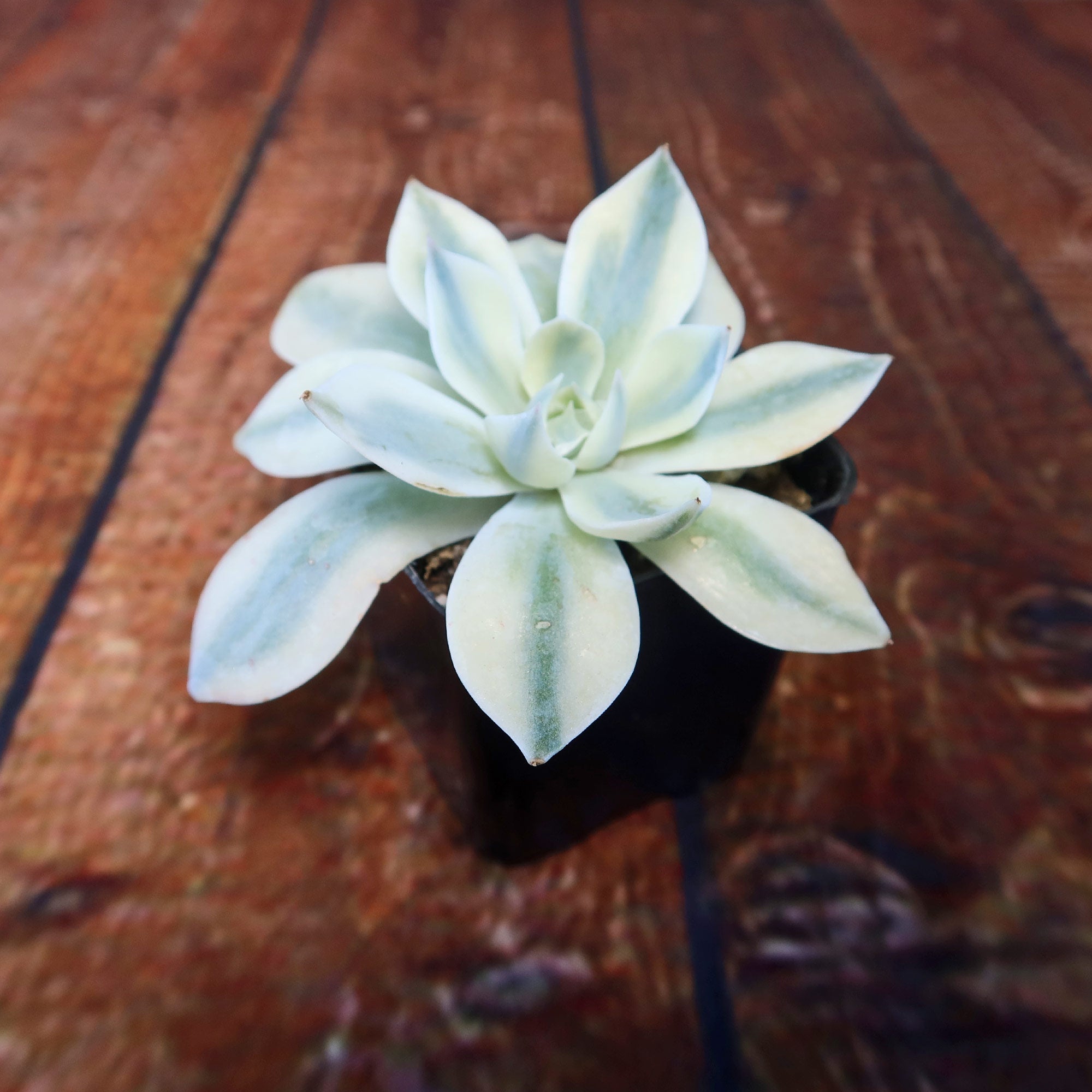
Echeveria subsessilis ‘Variegata’ is a highly sought-after succulent known for its soft pastel tones and elegant rosette. This variegated cultivar stands out for its creamy white, pale yellow, and blue-green foliage, often blushed with pink along the edges when grown in bright light. Its compact growth, ornamental appeal, and relatively easy care have made it especially popular among collectors, indoor plant enthusiasts, and succulent gardeners looking for a refined yet eye-catching plant.
Native to Mexico, the Echeveria subsessilis ‘Variegata’ has a symmetrical rosette composed of thick, spoon-shaped leaves. The foliage displays irregular variegation patterns, meaning no two plants look exactly alike. Under strong light, the leaf margins often develop soft pink or coral hues, enhancing its ornamental value. The leaves have a smooth, slightly powdery surface that helps reduce moisture loss.

At maturity, this Echeveria succulent remains relatively compact, typically reaching 8 inches wide and about 6 inches tall.
It may slowly produce offsets over time, forming small clumps, though variegated plants tend to grow more slowly than non-variegated forms.
This modest size makes it ideal for containers, windowsills, dish gardens, and succulent arrangements.
Flowering usually occurs in spring to early summer, when the plant sends up slender stalks bearing bell-shaped flowers.
The blooms are typically coral, pink, or orange, providing a warm contrast to the pale foliage. While the flowers are attractive, many growers value this plant primarily for its foliage rather than its blooms. The flowers can attract pollinators when grown outdoors in suitable climates.
In terms of care, watering should follow a soak-and-dry method, allowing the soil to dry out completely between waterings. Overwatering is the most common cause of problems. Use a well-drained specialized succulent soil, opens in a new tab, ideally amended with perlite or pumice.

When grown indoors, provide bright, indirect light to some direct sunlight, such as near a south- or east-facing window. Ideal indoor temperatures range from 60–80°F.
Outdoors, it performs best in USDA Zones 9–11, where it should be placed in bright light with some protection from intense afternoon sun.
Fertilizer is rarely needed, but a diluted, balanced succulent fertilizer can be applied once during the growing season.
Final Thoughts
Overall, the Echeveria subsessilis ‘Variegata’ is an elegant, drought-tolerant succulent that combines beauty with manageable care requirements. Its soft coloration, compact form, and versatility as an indoor or outdoor plant make it a favorite among collectors and beginners alike. When given proper light, excellent drainage, and careful watering, this variegated echeveria can remain a stunning focal point for many years.
Bloom Season
Flower Color
Growth Rate
Hardiness Zone
Mature Size
Plant Type
Resistance
Sun Exposure
Watering Needs
| Attribute | Value |
|---|---|
| Bloom Season | Spring, early summer |
| Botanical Name | Echeveria subsessilis variegata |
| Dormancy | Winter |
| Family | Crassulaceae |
| Flower Color | Coral pink, orange |
| Genus | Echeveria |
| Growth Habit | Rosette |
| Growth Rate | Fast |
| Hardiness Zone | 9, 10, 11 |
| Mature Size | 8 in. wide, 6 in. tall |
| Native Area | Mexico |
| Plant Type | Succulent |
| Propagation | By cuttings |
| Resistance | Extremely drought-tolerant, heat tolerant, pest resistance |
| Soil PH | 6.5, Acidic, Neutral |
| Soil Type | Succulents potting mix soil |
| Special Features | Easy to maintain, easy to grow |
| Sun Exposure | Full sun (6+ hrs.), Partial shade (3–6 hrs. sun) |
| Toxicity | Safe for humans, friendly to dogs, friendly to cats |
| Watering Needs | Low |
Growers Quick Reference Guide - Key Features
| Attribute | Value |
|---|---|
| Bloom Season | Spring, early summer |
| Botanical Name | Echeveria subsessilis variegata |
| Dormancy | Winter |
| Family | Crassulaceae |
| Flower Color | Coral pink, orange |
| Genus | Echeveria |
| Growth Habit | Rosette |
| Growth Rate | Fast |
| Hardiness Zone | 9, 10, 11 |
| Mature Size | 8 in. wide, 6 in. tall |
| Native Area | Mexico |
| Plant Type | Succulent |
| Propagation | By cuttings |
| Resistance | Extremely drought-tolerant, heat tolerant, pest resistance |
| Soil PH | 6.5, Acidic, Neutral |
| Soil Type | Succulents potting mix soil |
| Special Features | Easy to maintain, easy to grow |
| Sun Exposure | Full sun (6+ hrs.), Partial shade (3–6 hrs. sun) |
| Toxicity | Safe for humans, friendly to dogs, friendly to cats |
| Watering Needs | Low |
- Description
- Key Plant Features
Echeveria subsessilis ‘Variegata’ is a highly sought-after succulent known for its soft pastel tones and elegant rosette. This variegated cultivar stands out for its creamy white, pale yellow, and blue-green foliage, often blushed with pink along the edges when grown in bright light. Its compact growth, ornamental appeal, and relatively easy care have made it especially popular among collectors, indoor plant enthusiasts, and succulent gardeners looking for a refined yet eye-catching plant.
Native to Mexico, the Echeveria subsessilis ‘Variegata’ has a symmetrical rosette composed of thick, spoon-shaped leaves. The foliage displays irregular variegation patterns, meaning no two plants look exactly alike. Under strong light, the leaf margins often develop soft pink or coral hues, enhancing its ornamental value. The leaves have a smooth, slightly powdery surface that helps reduce moisture loss.
At maturity, this Echeveria succulent remains relatively compact, typically reaching 8 inches wide and about 6 inches tall.
It may slowly produce offsets over time, forming small clumps, though variegated plants tend to grow more slowly than non-variegated forms.
This modest size makes it ideal for containers, windowsills, dish gardens, and succulent arrangements.
Flowering usually occurs in spring to early summer, when the plant sends up slender stalks bearing bell-shaped flowers.
The blooms are typically coral, pink, or orange, providing a warm contrast to the pale foliage. While the flowers are attractive, many growers value this plant primarily for its foliage rather than its blooms. The flowers can attract pollinators when grown outdoors in suitable climates.
In terms of care, watering should follow a soak-and-dry method, allowing the soil to dry out completely between waterings. Overwatering is the most common cause of problems. Use a well-drained specialized succulent soil, opens in a new tab, ideally amended with perlite or pumice.
When grown indoors, provide bright, indirect light to some direct sunlight, such as near a south- or east-facing window. Ideal indoor temperatures range from 60–80°F.
Outdoors, it performs best in USDA Zones 9–11, where it should be placed in bright light with some protection from intense afternoon sun.
Fertilizer is rarely needed, but a diluted, balanced succulent fertilizer can be applied once during the growing season.
Final Thoughts
Overall, the Echeveria subsessilis ‘Variegata’ is an elegant, drought-tolerant succulent that combines beauty with manageable care requirements. Its soft coloration, compact form, and versatility as an indoor or outdoor plant make it a favorite among collectors and beginners alike. When given proper light, excellent drainage, and careful watering, this variegated echeveria can remain a stunning focal point for many years.
Bloom Season
Flower Color
Growth Rate
Hardiness Zone
Mature Size
Plant Type
Resistance
Sun Exposure
Watering Needs
| Attribute | Value |
|---|---|
| Bloom Season | Spring, early summer |
| Botanical Name | Echeveria subsessilis variegata |
| Dormancy | Winter |
| Family | Crassulaceae |
| Flower Color | Coral pink, orange |
| Genus | Echeveria |
| Growth Habit | Rosette |
| Growth Rate | Fast |
| Hardiness Zone | 9, 10, 11 |
| Mature Size | 8 in. wide, 6 in. tall |
| Native Area | Mexico |
| Plant Type | Succulent |
| Propagation | By cuttings |
| Resistance | Extremely drought-tolerant, heat tolerant, pest resistance |
| Soil PH | 6.5, Acidic, Neutral |
| Soil Type | Succulents potting mix soil |
| Special Features | Easy to maintain, easy to grow |
| Sun Exposure | Full sun (6+ hrs.), Partial shade (3–6 hrs. sun) |
| Toxicity | Safe for humans, friendly to dogs, friendly to cats |
| Watering Needs | Low |
Growers Quick Reference Guide - Key Features
| Attribute | Value |
|---|---|
| Bloom Season | Spring, early summer |
| Botanical Name | Echeveria subsessilis variegata |
| Dormancy | Winter |
| Family | Crassulaceae |
| Flower Color | Coral pink, orange |
| Genus | Echeveria |
| Growth Habit | Rosette |
| Growth Rate | Fast |
| Hardiness Zone | 9, 10, 11 |
| Mature Size | 8 in. wide, 6 in. tall |
| Native Area | Mexico |
| Plant Type | Succulent |
| Propagation | By cuttings |
| Resistance | Extremely drought-tolerant, heat tolerant, pest resistance |
| Soil PH | 6.5, Acidic, Neutral |
| Soil Type | Succulents potting mix soil |
| Special Features | Easy to maintain, easy to grow |
| Sun Exposure | Full sun (6+ hrs.), Partial shade (3–6 hrs. sun) |
| Toxicity | Safe for humans, friendly to dogs, friendly to cats |
| Watering Needs | Low |